 Book Bearings
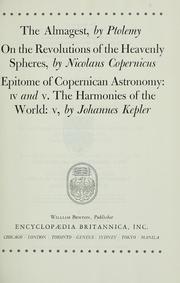
The Almagest
- 889 pages · about 15 hours
- First published 1948
- 13 editions
Bookshop.org links may earn us a commission. It supports independent bookstores and costs you nothing.
1 About this book
The Almagest ( AL-mə-jest) is a 2nd-century mathematical and astronomical treatise on the apparent motions of the stars and planetary paths, written by Claudius Ptolemy (c. AD 100 – c. 170) in Koine Greek. One of the most influential scientific texts in history, it canonized a geocentric model of the universe that was accepted for more than 1,200 years from its origin in ancient Greece, through to the medieval Byzantine and Islamic worlds, and in Western Europe through the Middle Ages and early Renaissance until the Scientific Revolution. It is also a key source of information about ancient Greek astronomy.
Ptolemy set up a public inscription at Canopus, Egypt, in 147 or 148. Norman T. Hamilton found that the version of Ptolemy's models set out in the Canopic Inscription was earlier than the version in the Almagest. Hence the Almagest could not have been completed before about 150, a quarter-century after Ptolemy began observing.
Summary adapted from Wikipedia (CC BY-SA 4.0)
Good for readers who want: astronomy and a long read.
- Addresses, essays
- Astronomy
- Greek Mathematics
- Stars
- Catalogs
2 About Ptolemy

Bio adapted from Wikipedia (CC BY-SA 4.0)
3 Similar books
- The Mythology of the Night Sky by David E. Falkner
- A Brief History of Time by Stephen Hawking
- Cosmos by Carl Sagan
- The Mathematical Principles of Natural Philosophy by Sir Isaac Newton
- Poetry, Language, Thought by Martin Heidegger
- The Mythical Man-Month by Frederick P. Brooks
- Brief Answers to the Big Questions by Stephen Hawking
- On War by Carl von Clausewitz