 Book Bearings
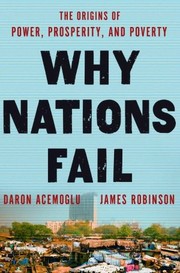
Why Nations Fail
- 529 pages · about 9 hours
- First published 2012
- 15 editions
Bookshop.org links may earn us a commission. It supports independent bookstores and costs you nothing.
1 About this book
Why are some nations rich and others poor, divided by wealth and poverty, health and sickness, food and famine?
Is it culture, the weather, or geography that determines prosperity or poverty? As Why Nations Fail shows, none of these factors is either definitive or destiny. Drawing on fifteen years of original research, Daron Acemoglu and James Robinson conclusively show that it is our man-made political and economic institutions that underlie economic success (or the lack of it). Korea, to take just one example, is a remarkably homogeneous nation, yet the people of North Korea are among the poorest on earth while their brothers and sisters in South Korea are among the richest. The differences between the Koreas is due to the politics that created those two different institutional trajectories.
Will China's economy continue to grow at such a high speed and ultimately overwhelm the West?
Are America's best days behind it?
Good for readers who want: economics, history, and a long read.
- Revolutions
- Economic development
- Economics
- Economic policy
- Economic history
- History
- Industrial revolution
- Social policy
2 About Daron Acemoglu

Bio adapted from Wikipedia (CC BY-SA 4.0)
3 Similar books
- Limits to Growth by Donella H. Meadows
- Changing World Order by Ray Dalio
- 1493 by Charles C. Mann
- Sapiens by Yuval Noah Harari
- A Short History of Nearly Everything by Bill Bryson
- The Communist Manifesto by Karl Marx
- The Immortal Life of Henrietta Lacks by Rebecca Skloot
- The Structure of Scientific Revolutions by Thomas S. Kuhn