 Book Bearings
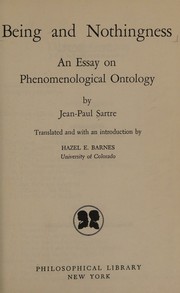
Being and Nothingness
- 716 pages · about 12 hours
- First published 1943
- 86 editions
Bookshop.org links may earn us a commission. It supports independent bookstores and costs you nothing.
1 About this book
Being and Nothingness: An Essay on Phenomenological Ontology (French: L'Être et le néant : Essai d'ontologie phénoménologique), sometimes published with the subtitle A Phenomenological Essay on Ontology, is a 1943 book by the philosopher Jean-Paul Sartre. In the book, Sartre develops a philosophical account in support of his existentialism, dealing with topics such as consciousness, perception, social philosophy, self-deception, the existence of "nothingness", psychoanalysis, and the question of free will.
While a prisoner of war in 1940 and 1941, Sartre read Martin Heidegger's Being and Time (1927), which uses the method of Husserlian phenomenology as a lens for examining ontology. Sartre attributed the course of his own philosophical inquiries to his exposure to this work.
Summary adapted from Wikipedia (CC BY-SA 4.0)
Good for readers who want: philosophy and a long read.
- Existential psychology
- Existentialism
- Philosophy
- French Philosophy
- Ontology
- Phenomenology
- Angoisse
2 About Jean-Paul Sartre

Bio adapted from Wikipedia (CC BY-SA 4.0)
3 More by Jean-Paul Sartre
4 Similar books
- Zen and the Art of Motorcycle Maintenance by Robert M. Pirsig
- The Myth of Sisyphus by Albert Camus
- The Myth of Sisyphus and Other Essays by Albert Camus
- Poetry, Language, Thought by Martin Heidegger
- The Mind's I by Douglas R. Hofstadter
- Fanged Noumena by Nick Land
- Repetition by Søren Kierkegaard
- How to Win Friends and Influence People by Dale Carnegie