 Book Bearings
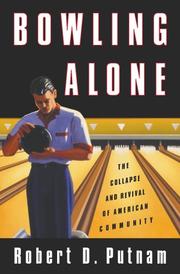
Bowling Alone
- 544 pages · about 9 hours
- First published 2000
- 6 editions
Bookshop.org links may earn us a commission. It supports independent bookstores and costs you nothing.
1 About this book
Updated to include a new chapter about the influence of social media and the Internet—the 20th anniversary edition of Bowling Alone remains a seminal work of social analysis, and its examination of what happened to our sense of community remains more relevant than ever in today’s fractured America.
Twenty years, ago, Robert Putnam made a seemingly simple observation: once we bowled in leagues, usually after work; but no longer. This seemingly small phenomenon symbolized a significant social change that became the basis of the acclaimed bestseller, Bowling Alone, which The Washington Post called “a very important book” and Putnam, “the de Tocqueville of our generation.”
Bowling Alone surveyed in detail Americans’ changing behavior over the decades, showing how we had become increasingly disconnected from family, friends, neighbors, and social structures, whether it’s with the PTA, church, clubs, political parties, or bowling leagues.
- History
- Sociology
- History, 20th Century
- Social conditions
- Social change
- Community life
- Social isolation
- Social values
2 What to expect
Expect a sweeping, data-driven argument that Americans have quietly lost their social fabric — civic participation, community organizations, and the habits of trust — over a single generation. Putnam builds his case from hundreds of statistics, surveys, and historical records, and the prose is dense, analytical, and deliberately unsentimental. It reads less like a narrative than a long, urgent essay. The central claim is simple and the evidence is overwhelming.
Good for readers who want: history and a long read.
3 About Robert D. Putnam

Bio adapted from Wikipedia (CC BY-SA 4.0)
4 Similar books
- The Immortal Life of Henrietta Lacks by Rebecca Skloot
- Open veins of Latin America by Eduardo Galeano
- Diffusion of Innovations by Everett M. Rogers
- Caliban and the Witch by Silvia Federici
- The Fire Next Time by James Baldwin
- The Souls of Black Folk by W. E. B. Du Bois
- A Vindication of Rights of Woman by Mary Wollstonecraft
- Women, Race & Class by Angela Y. Davis